Case Study
Using mathematics to locate the lost meteorites of Antarctica


Author



Professor David Abrahams
Keywords
planetry science
climate change
partial differential equations
Overview
The Project
Glaciers and climate change
Glaciers are huge masses of ice which form over hundreds of years, when snow accumulates and compacts into ice. They flow like very slow rivers under their own weight, and store most of the world’s freshwater. The melting of glaciers is used as a way to estimate long-term climate change.
Surface debris, such as rocks, stones, and dirt, is common on glaciers, and significantly affects the rate of glacier melt through albedo changes and other factors. Thus, to obtain accurate predictions of long-term climatic variation it is important to understand and offset the influence of the debris. During an environmental and climate workshop back in 2015, CHIMiRA mathematician, David Abrahams, together with interdisciplinary collaborators, improved an existing partial differential equation model of the debris. By adding in a moisture term, and consideration of the turbulent flow over and within the debris, their extended model was then able to accurately reproduce experimental field findings for the first time.
Unexpected consequences for planetary and solar-system science
In Antarctica, there are hotspots known as “meteorite stranding zones” for finding meteorites, which are rocks that came from outside the earth or its atmosphere. Field missions (by a number of countries including the USA and Japan) each year collect these meteorites as they are of great scientific interest, for better understanding the formation of our solar system, the constitution of comets and planets, and also the life and death of stars.
Of the 80,000 total of known meteorites found on the earth, over 60% (~50,000) have been picked up in Antarctica. But why is this so, as meteorites fall fairly uniformly over the planet? As Antarctica is a vast and uninhabited desert, with little geological activity and covered by large and slow flowing glaciers, over millennia meteorites fall in random locations, become buried in snow and ice, and then are transported within the glaciers towards the coast. Most of the meteorites will end up in the sea, taking many thousands of years to do so, but the meteorite stranding zones are relatively small areas where the ice has to flow over subglacial mountain peaks; this ice is pushed upwards and then become ‘trapped’. Strong winds erode this ice, bringing to the surface (or near to the surface) pristine (blue) ice as well as any meteorites trapped within it. These meteorites will have travelled from large ‘catchment areas’ to much smaller regions; hence the reason why they are so fertile for finding meteorites.
There is one curiosity from the meteorite finds– the percentage of iron-rich meteorites collected from Antarctica is far lower than found elsewhere in the world. This piqued Abrahams’ and the mathematicians’ interest as in their initial debris modelling work they had observed that debris, including meteorites, can go up or down in the ice due to changing conditions, such as melting, new snow/ refreezing, and seasonal warming through sunlight. Further theoretical research, and table-top experiments, led to a hypothesis that there was potentially a hidden layer of (iron-rich) meteorites ‘living’ just below the ice.
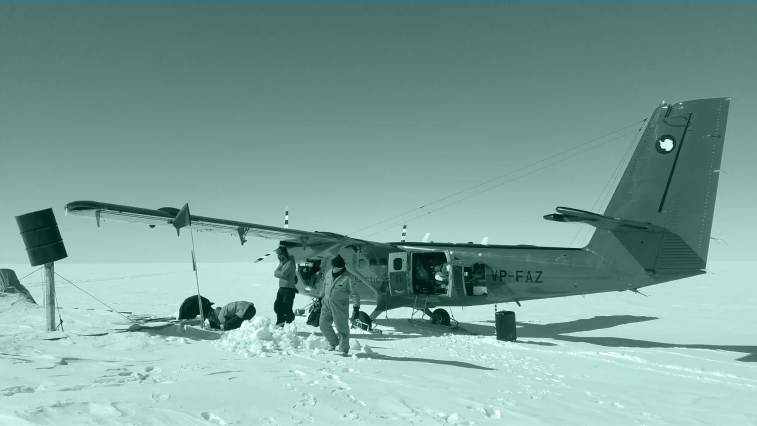
A broad team was formed, and funding procured, for a bold and risky field trip to try to locate some ‘lost’ meteorites as well as those on the surface. Working closely with the British Antarctic Survey, researchers planned and executed the very first UK-led meteorite collection mission to previously unvisited regions of Antarctica. The project confirmed two new high-density meteorite stranding zones, and recovered 121 meteorites which are now mostly housed in the Natural History Museum London undergoing analysis.
Further applications
The original debris model has continued to be used extensively by others since 2015; Abrahams and colleagues have applied the theory to two different studies. One is to help understand a remarkable and rare feature, now coined ice-sails, which occur on high altitude glaciers such as those in the Karakoram mountain range. The other is to explain the presence and orientation of ice cliffs on debris covered glaciers, which can significantly enhance the melting process.


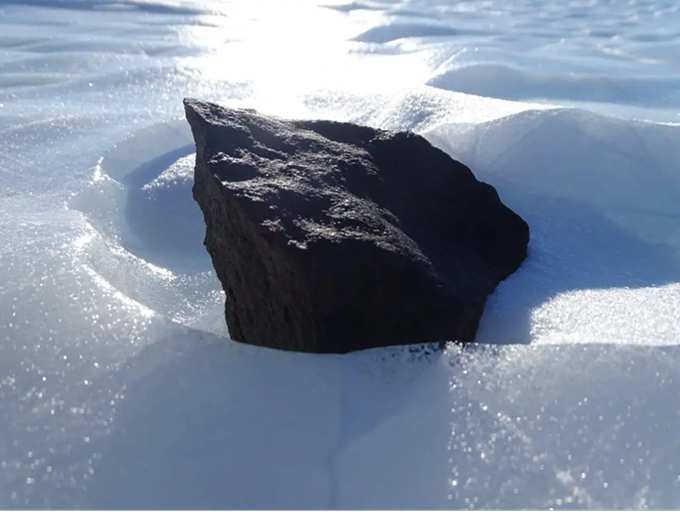
Meteorite find in Antarctica.
Image source: https://ukantarcticmeteorites.wordpress.com/antarctica-fieldwork-photos/
Acknowledgements
Keep Reading
View all case studiesSee maths in action









Connect with us
Explore how CHIMiRA can transform your research or business challenges through mathematical innovation. We are an open house for ideas and consider projects from any academic discipline, business, industry or the third sector.
Contact us