Case Study
Using AI to Hunt for Hidden Allergens in the Human Microbiome



Author



Dr Sergio Bacallado de Lara
Keywords
protein language models
metagenomics
deep learning
Overview
The Project
The challenge
Despite their prevalence, the precise triggers of allergic diseases remain a puzzle. While typically linked to external factors like pollen or peanuts, scientists increasingly suspect that the microbiome—the trillions of microbes living naturally inside us—plays a crucial role. However, finding the specific microbial proteins that trigger allergies is notoriously difficult. Proteins can evolve to have completely different genetic sequences while still performing the exact same biological function. Traditional sequence-based search tools, which look for obvious genetic copycats, often completely miss these disguised allergens.
Learning to spot the unseen
To overcome this "remote homology" challenge, mathematicians at CHIMiRA teamed up with researchers at the Broad Institute, Harvard University, and Massachusetts General Hospital. Together, they turned to a powerful new paradigm in artificial intelligence: foundation models.
The team leveraged Protein Language Models, which rely on the same underlying architecture that powers large language models for text. Because these models already capture the complex structural representations of proteins, the researchers were able to build a highly specialized classifier on top of them. The real computational breakthrough, however, was in how they trained it using existing databases of annotated allergens. They guided the model to heavily prioritize a small set of known allergens while carefully managing the uncertainty of a stratified set of unlabeled proteins. By screening millions of proteins from the human gut and mouth, the model learned to read the subtle, hidden structural patterns that make a protein allergenic, even when its genetic sequence looks completely unfamiliar.


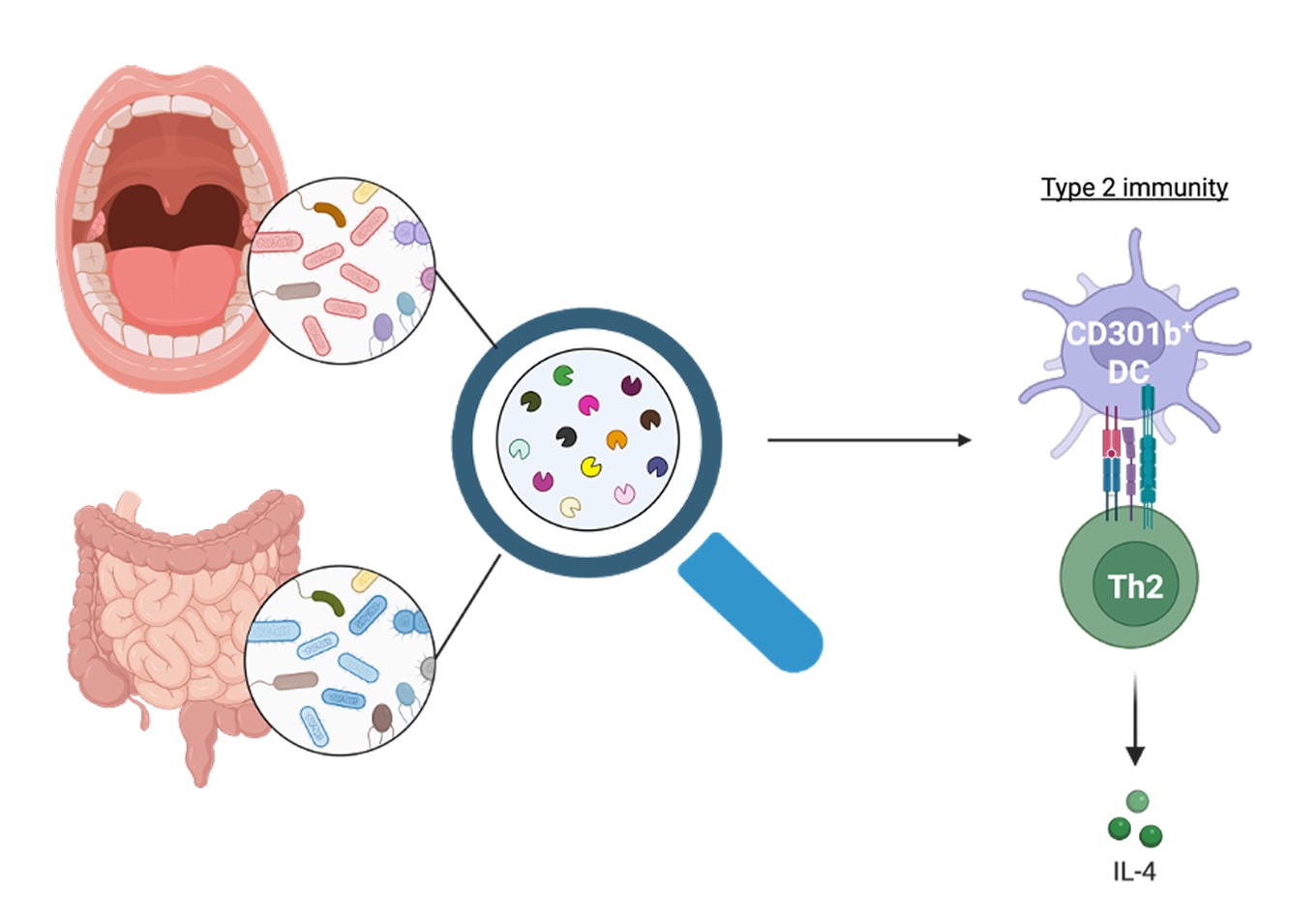
The researchers used AI to identify hidden microbial allergens in the human gut and mouth.
Unmasking new triggers
The AI successfully cataloged hundreds of potential new microbial allergens. To prove the model's accuracy, the team selected two highly unlikely candidates—one from the gut and one from the mouth—that showed very low sequence similarity with known allergens.
When tested experimentally, both proteins triggered a potent allergic immune response. Surprisingly, the AI also demonstrated its ability to generalize beyond its core training data: though the model was exclusively trained on one specific class of enzymes (serine proteases), it successfully identified an entirely different class of allergen (a cysteine protease).
This breakthrough provides a robust new pipeline of predictions that will guide future allergy research. By mapping these hidden triggers, scientists are taking a major step toward understanding the root mechanisms of allergic reactions, paving the way for highly targeted medical treatments and preventative therapies in the future.
Acknowledgements
Keep Reading
View all case studiesSee maths in action







Connect with us
Explore how CHIMiRA can transform your research or business challenges through mathematical innovation. We are an open house for ideas and consider projects from any academic discipline, business, industry or the third sector.
Contact us